Crash Game Patterns & RTP Explained — South Africa 2026 | Fatbet
Do crash game patterns actually exist? Honest guide to variance, RTP and common myths — covering JetX, Plinko X and Balls of Dreams at Fatbet SA. Know the math before you play.
Crash Game Patterns: Variance, RTP & Reality Check — A Player's Honest Guide
I've watched a lot of players lose money in crash games not because the games are unfair, but because they were playing with a completely incorrect model of how these games actually work. They were chasing patterns, adjusting stakes after streaks, waiting for "due" multipliers. None of it helped. Most of it accelerated their losses.
This guide is a direct examination of crash game mathematics — how variance actually distributes results, what RTP means and doesn't mean in practice, why your brain lies to you about patterns, and how the specific games available at Fatbet's crash section behave differently from each other. The goal isn't to kill your enjoyment of crash games. It's to make sure you're playing them with an accurate picture of what's happening.
⚠️ Important: Crash games are games of chance. No strategy, pattern recognition system, or betting progression eliminates the house edge. Every claim in this article is based on published mathematics and provider documentation — not anecdote or theory.
How Crash Games Actually Work: The Mathematics First
Before any discussion of patterns or strategy, the mechanism needs to be understood precisely.
Every crash game round runs on a Random Number Generator (RNG) or a provably fair cryptographic algorithm. The crash point — the multiplier at which the round ends — is calculated and fixed before the animation begins. What you see on screen is a visual representation of a result that already exists.
This single fact destroys the entire premise of pattern-based crash game strategy. Here's why:
Common Belief | Mathematical Reality |
|---|---|
"After 5 low crashes, a high one is due" | Each round is fully independent — previous results have zero influence |
"The game goes high after long low streaks to 'balance out'" | RNG has no memory and no balancing mechanism within short timeframes |
"If I watch the pattern, I can predict the next crash" | The outcome existed before the round started — observation changes nothing |
"Other players cashing out at 2x means 2x is 'safe'" | Other players have no information you don't — they're guessing too |
"High multipliers come in clusters" | Cluster appearance is a natural feature of random sequences, not a pattern |
The last point deserves expansion because it's the one most players misunderstand. Random sequences routinely produce what looks like clustering — five low crashes in a row, then two 10x+ rounds close together. This feels meaningful. It isn't. It's exactly what statisticians expect random sequences to look like. The absence of clustering would actually indicate the sequence was NOT random.
What Provably Fair Actually Means — and What It Doesn't
Fatbet's crash games include provably fair titles like JetX from SmartSoft Gaming. Players frequently confuse "provably fair" with "player-verifiable fairness" — which is accurate — and incorrectly extend this to mean "predictable" or "pattern-visible."
What Provably Fair Guarantees | What It Does NOT Guarantee |
|---|---|
Results are generated before the round starts | That results will distribute evenly in your session |
No post-round manipulation by the operator | That high multipliers will follow low ones |
You can verify each result using the published seed | That any strategy will produce positive expected value |
The house edge is exactly as stated | That short-term results will reflect the stated RTP |
Results are cryptographically independent | That watching results reveals upcoming outcomes |
Provably fair is about integrity verification, not prediction capability. A SHA256 hash published before a round proves the result wasn't changed after the fact. It does not give you any information about what the result will be before it happens.
RTP in Crash Games: The Number That Misleads Most Players
Most crash games at Fatbet operate at 96–97% RTP. This is frequently misunderstood in ways that directly cause poor decision-making.
What 97% RTP actually means:
Over millions of rounds played by all players combined, 97% of total money wagered is returned as winnings. The house retains 3%.
What 97% RTP does NOT mean:
Incorrect Interpretation | Why It's Wrong |
|---|---|
"I'll get back R97 of every R100 I bet tonight" | Short-term variance creates massive deviation from RTP |
"After losing R100, I'm owed R97 back" | There is no debt mechanism — each round is independent |
"Higher RTP means more wins" | High-variance games with 97% RTP can still produce 20+ consecutive losses |
"RTP changes if I bet bigger" | RTP is fixed by the game mathematics, not bet size |
"If I've been losing, RTP will correct itself toward me" | RTP correction happens across millions of rounds, not within your session |
The practical impact of RTP across different session sizes:
Session Rounds | Expected Loss at 3% House Edge | Actual Range (95% probability) |
|---|---|---|
10 rounds × R10 = R100 wagered | R3 expected | R-100 to +R80 (huge variance) |
100 rounds × R10 = R1,000 wagered | R30 expected | R-400 to +R340 |
1,000 rounds × R10 = R10,000 wagered | R300 expected | R-900 to +R300 |
10,000 rounds × R10 = R100,000 wagered | R3,000 expected | Tightening toward expected value |
💡 The key insight: In a 10-round session, the "expected" loss of R3 is statistically meaningless — the actual outcome could be anywhere in a R180 range. This is variance in action. Players who interpret a winning session as skill confirmation and a losing session as bad luck are experiencing both sides of normal variance distribution.
Crash Games Available at Fatbet: How Variance Differs Between Titles
Not all crash games on Fatbet's platform behave identically. The same 97% RTP can be distributed very differently depending on a game's volatility design. Here's how the key titles compare:
JetX (SmartSoft Gaming) — 97% RTP, Medium–High Volatility
JetX is the most technically sophisticated crash game on Fatbet's platform. The dual-bet system allows two simultaneous bets with independent cash-out targets — a structural feature that changes variance management.
Feature | Detail |
|---|---|
Provider | SmartSoft Gaming |
RTP | 97% |
House edge | 3% |
Max multiplier | 25,000x |
Dual bet | Yes |
Provably fair | Yes |
Volatility profile | Medium–High |
Variance behaviour: JetX produces a standard crash distribution — approximately 25% of rounds crash below 1.5x, 50% below 2x. The 25,000x maximum creates occasional extreme outlier rounds that skew perception of "how high it goes."
The dual-bet reality check: Many players use JetX's dual-bet feature to run a "conservative" bet at 1.5x auto cash-out alongside a "speculative" bet running for higher multipliers. This does not change the house edge — both bets carry 3% edge independently. What it does is smooth the session experience by converting some all-or-nothing rounds into partial-win rounds. The mathematics are unchanged.
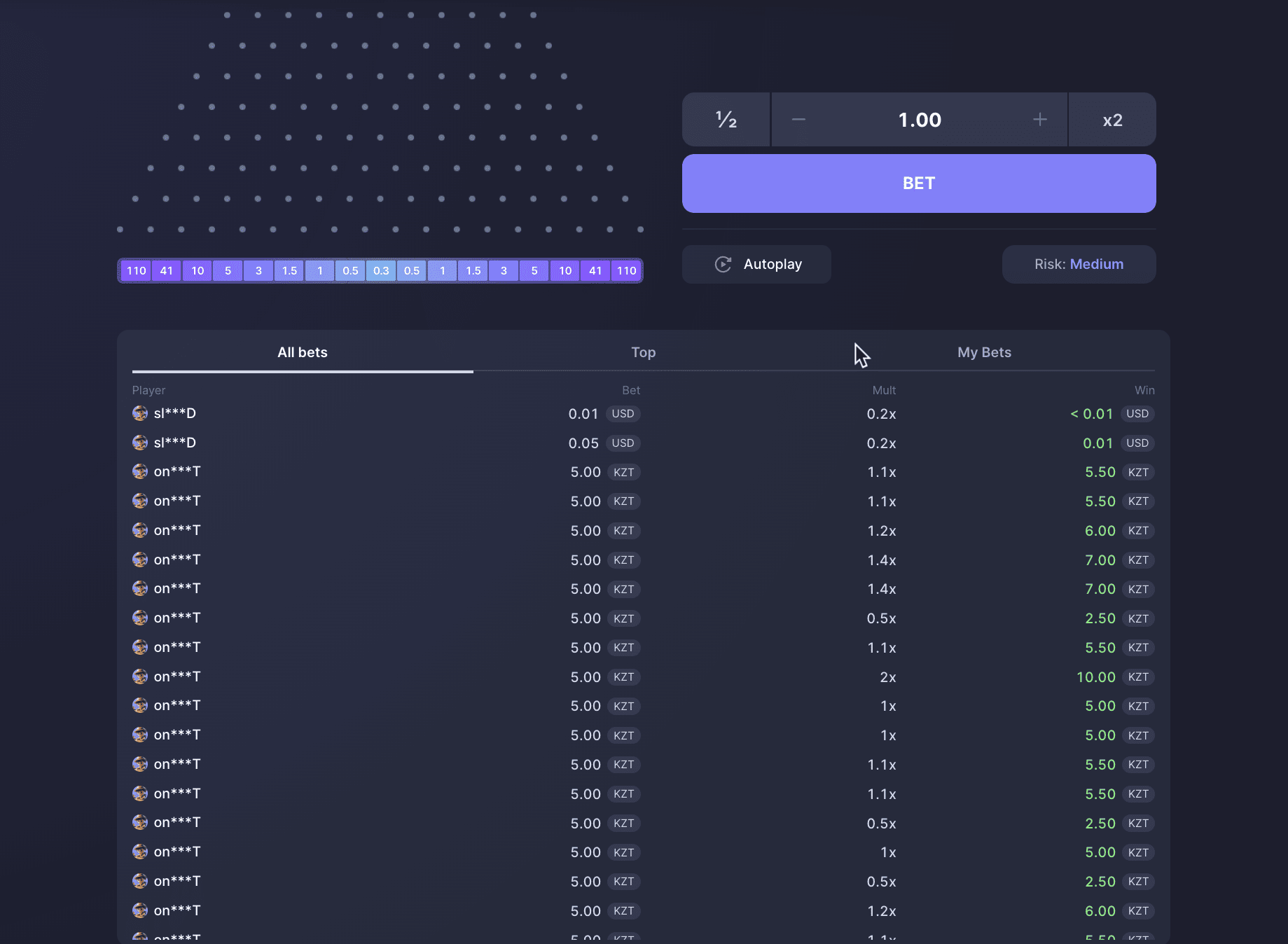
Plinko X (SmartSoft Gaming) — Up to 97% RTP, Adjustable Volatility
Plinko X removes the timing element entirely, which changes the variance experience significantly compared to standard crash games.
Feature | Detail |
|---|---|
Provider | SmartSoft Gaming |
RTP | Up to 97% |
Risk levels | Low / Medium / High |
Max multiplier | 1,000x+ |
Decision timing | Before the ball drops |
Volatility | Adjustable |
Variance behaviour by risk level:
Risk Level | Win Frequency | Typical Win Size | Bankroll Survival |
|---|---|---|---|
Low | High (frequent small wins) | 0.2x–3x | Best — many positive rounds |
Medium | Moderate | 0.5x–10x | Moderate — balanced outcomes |
High | Low (infrequent large wins) | 1x–1,000x | Worst — long cold runs normal |
The risk-level pattern trap: Players frequently switch from low risk to high risk after a sequence of small wins, believing they've "earned" a big hit. This is gambler's fallacy applied to Plinko's risk selection — the ball's destination is random regardless of what previous balls did on any risk setting.
Balls of Dreams (R-evolution) — Unique Physics-Based Crash Format
Balls of Dreams is R-evolution's entry in the crash category — one of the most-played titles in Fatbet's overall catalogue. It uses a physical ball mechanic where trajectory and timing interact with the multiplier structure.
Feature | Detail |
|---|---|
Provider | R-evolution |
Format | Physics multiplier game |
Demo mode | Yes |
Multiplayer | Yes |
Volatility | Medium |
What makes it different from standard crash: The physical ball trajectory creates a visual complexity that standard multiplier-climbing games lack. This additional visual information has no bearing on outcomes — the ball's path is determined by the same RNG as every other crash game. However, players frequently develop "read the physics" theories that feel compelling and are entirely without mathematical basis.
Standard Crash (Fatbet Platform) — Maximum Multiplier 1,000,000x
Fatbet's native Crash game features a 1,000,000x maximum multiplier — the highest on the platform — with a real-time multiplayer social format.
Feature | Detail |
|---|---|
Format | Standard crash multiplier |
Max multiplier | 1,000,000x |
Round interval | 5-second betting window |
Bet types | Manual and Auto-bet |
Hotkeys | Yes (s/a/d/space/q) |
Community leaderboard | Real-time |
The 1,000,000x trap: The theoretical maximum multiplier of one million times creates a powerful psychological anchor. Players think about the possibility of a 1,000,000x round far more than its actual probability warrants. The frequency of such a multiplier appearing is astronomically low — for context, a game with 3% house edge would produce a 1,000,000x multiplier at a probability of approximately 0.000003% per round. This is not a target worth designing your session around.
The social leaderboard effect: Watching other players' bets and cash-outs in real time creates what psychologists call social proof bias — the instinct that if many players are cashing out at 3x, 3x must be a meaningful threshold. It isn't. Those players have identical information to you (none regarding future outcomes) and are making decisions based on their own arbitrary targets, risk tolerance, and — frequently — the same misunderstandings about patterns described throughout this guide.
The Five Crash Game "Strategies" That Don't Work — and Why
1. Pattern Tracking
What players do: Record previous multipliers, look for cycles, bet based on identified sequences.
Why it fails: Crash results are independent events. A sequence of 10 rounds is statistically too small to distinguish from random noise even if patterns existed — which they don't. The human brain is specifically evolved to find patterns in random data. This was useful for survival (spotting predator patterns in jungle movement). It actively harms crash game players.
The data: If you tracked 1,000 JetX rounds and found that after 3 consecutive sub-2x crashes, the next round averaged 4x, this would be a coincidence produced by sample size. Running the same analysis on the next 1,000 rounds would produce a different "pattern" — because there is no pattern.
2. Martingale (Double After Loss)
What players do: Double the stake after each loss to recover previous losses in one win.
Why it fails at crash specifically:
Martingale Sequence | Cumulative Loss | Stake Required to Recover |
|---|---|---|
1 loss | R10 | R20 |
2 consecutive losses | R30 | R40 |
3 consecutive losses | R70 | R80 |
5 consecutive losses | R310 | R320 |
7 consecutive losses | R1,270 | R1,280 |
10 consecutive losses | R10,230 | R10,240 |
A sequence of 10 consecutive losses at 1.5x auto cash-out target — where approximately 34% of rounds crash below 1.5x — has a probability of approximately 0.34^10 = 0.02%. That sounds safe until you consider that in 5,000 rounds, this event becomes statistically expected to occur at least once. Players at R10 base stakes hit table or bankroll limits long before the recovery win arrives.
Crash makes Martingale more dangerous than in roulette or blackjack because crash games can produce longer consecutive losing streaks than even-money table games. A 1.5x auto cash-out crashes (loses) in approximately 1 in 3 rounds — a higher individual-round loss rate than a roulette even-money bet.
3. High Cashout Patience Strategy
What players do: Set a fixed target of 10x or 20x, use small stakes, wait for the big hit.
Why it has a hidden cost most players miss:
Target Multiplier | Approximate Hit Frequency | Rounds to Expect One Hit | Cost at R5 stake |
|---|---|---|---|
2x | ~50% | ~2 rounds | ~R10 |
5x | ~20% | ~5 rounds | ~R25 |
10x | ~10% | ~10 rounds | ~R50 |
20x | ~5% | ~20 rounds | ~R100 |
50x | ~2% | ~50 rounds | ~R250 |
100x | ~1% | ~100 rounds | ~R500 |
A player targeting 100x at R5 per round spends approximately R500 in losses before hitting the target once — netting R5 × 100 = R500 minus R500 in losses = R0 in this theoretical exact-probability scenario. In reality, variance means sometimes you hit it in 10 rounds (R50 total cost, R450 profit) and sometimes you don't hit it in 200 rounds (R1,000 loss, still no win). The house edge ensures that across enough rounds, you'll be on the wrong side of this by 3%.
4. The "Safe Zone" Strategy
What players do: Target multipliers between 1.5x and 2x on every round, reasoning that this range is "safe" because it's common.
Why it doesn't produce positive expectation:
A 1.5x auto cash-out on a 97% RTP game means:
Approximately 66% of rounds pay 1.5x (net +50% on stake)
Approximately 34% of rounds crash below 1.5x (net -100% on stake)
Expected value per round: (0.66 × 0.5) − (0.34 × 1.0) = 0.33 − 0.34 = −0.01 per unit
The house edge appears regardless of the multiplier target. There is no cash-out target that produces positive expected value in a negative-expectancy game.
5. The Progressive Win Strategy
What players do: Increase stakes after wins, reasoning that they're "playing with house money" and can afford more risk.
Why this framing is mathematically incorrect: Money won in previous rounds is your money, not the house's. Each new round starts fresh with zero connection to what came before. Betting R100 after three consecutive wins is identical in expected value to betting R100 at the start of a session. The previous wins don't make the next round safer — they just mean your current bankroll is larger.
The practical danger is that win-streak momentum encourages stake escalation during variance peaks, maximising exposure at the exact moment regression toward the mean is statistically due.
What Actually Affects Your Crash Game Results
Since patterns, betting systems, and multiplier targeting don't change expected value, what does?
Factor | Effect on Results | Your Control |
|---|---|---|
Game RTP | Determines long-run house edge | Choose higher RTP games (JetX/Plinko X at 97%) |
Stake size | Determines absolute ZAR variance | Full control — keep stakes small relative to bankroll |
Session length | More rounds = closer to expected RTP | Shorter sessions = more variance, potentially favourable |
Auto cash-out vs manual | Removes emotional interference | Use auto cash-out consistently |
Bankroll size | Determines ability to survive variance | Higher bankroll absorbs cold streaks better |
Stopping rules | Determines whether wins are kept | Pre-set stop-loss and win target before session |
The two factors you can most meaningfully control are stake sizing and stopping rules. Neither changes the house edge, but both change whether variance has time to work against you catastrophically.
Variance Reality: What Crash Game Sessions Actually Look Like
This is the section most guides skip because it's not encouraging. Here's an honest picture of how crash game sessions distribute for a player using 1.5x auto cash-out at R10 per round on a 97% RTP game:
Session Length | Best-Case Outcome (top 10%) | Median Outcome | Worst-Case Outcome (bottom 10%) |
|---|---|---|---|
20 rounds (R200 wagered) | +R120 | -R30 | -R200 |
50 rounds (R500 wagered) | +R150 | -R50 | -R350 |
100 rounds (R1,000 wagered) | +R180 | -R80 | -R500 |
200 rounds (R2,000 wagered) | +R100 | -R160 | -R800 |
The median outcome is negative in all cases — this is the house edge at work. The best-case outcomes are achievable (top 10% of sessions land here) but require variance to run strongly in your favour. The worst-case outcomes are also achievable, which is why session limits are essential.
A Realistic Crash Game Framework for Fatbet Players
Given everything above, here is the most rational approach to crash games:
Before the session:
Decision | Recommended Approach |
|---|---|
Session budget | Set an amount you're comfortable losing entirely |
Stake per round | 1–2% of session budget maximum |
Auto cash-out target | Set before opening the game — don't change mid-session |
Stop-loss | 30–40% of session budget |
Win target | 100% of session budget (double up and leave) |
Game selection | JetX or Plinko X for best documented RTP on Fatbet |
During the session:
Situation | Correct Response |
|---|---|
5 consecutive losses | Continue with same stake — don't change anything |
3 consecutive wins | Continue with same stake — don't increase |
Feeling the urge to "chase" a big multiplier | Recognise this as emotional response to variance |
Reaching stop-loss | Stop immediately — the next round has the same odds |
Reaching win target | Stop immediately — variance does not owe you more |
After the session:
Do not analyse individual rounds for patterns. The only useful post-session analysis is: did you stick to your pre-set rules? If yes, the session was successful regardless of financial outcome. If no, identify which moment the rules broke down and why.
Crash Games vs Other Fatbet Formats: The Honest Comparison
Format | House Edge | Skill Element | Variance | Session Control |
|---|---|---|---|---|
Crash games (JetX, Plinko X) | 3% | Low | High | Moderate (auto cash-out) |
Live Blackjack (basic strategy) | 0.5% | High | Low–Medium | High |
Live Baccarat (Banker) | 1.06% | None | Low | High |
European Roulette | 2.7% | None | Medium | Moderate |
High RTP Slots (97%+) | 3% | None | Variable | Low (spin speed) |
Crash games sit at the same house edge as high-RTP slots but with a fundamentally different player experience — you make one decision per round instead of zero, which creates the feeling of agency that makes crash games compelling. That feeling is real in the sense of engagement, but not in terms of mathematical influence.
Responsible Gambling Resources in South Africa
Organisation | Contact | Service |
|---|---|---|
National Responsible Gambling Programme | 0800 006 008 | Free 24/7 helpline |
National Gambling Board | www.ngb.org.za | Licence verification and complaints |
Gamblers Anonymous South Africa | www.gamblersanonymous.org.za | Support groups |
If gambling is affecting your finances, relationships, or mental health, contact the NRGP helpline on 0800 006 008 — free, confidential, and available 24 hours a day.
Crash games at Fatbet — JetX, Plinko X, Balls of Dreams, the platform's native Crash — are genuinely entertaining formats with a straightforward house edge of around 3%. They're fair. The provably fair systems work. The RTPs are competitive with slots.
What they are not is pattern-readable, strategy-defeatable, or streak-exploitable. Every multiplier is independent. Every round starts from the same mathematical position. The distribution of results over your session is controlled by variance, not by anything that came before.
The players who consistently enjoy crash games without destructive financial outcomes are not the ones who cracked the pattern. They're the ones who accepted there is no pattern, set strict session limits, and treated the cash-out decision as entertainment rather than an information-gathering exercise.
Play the mathematics honestly. The games will take care of the rest.
